Area
export area, signed_areaWhat is area? What is signed area?
Area is the amount of space occupied by a two-dimensional figure. It is always a positive value. Signed area is simply the integral over the exterior path of a polygon, minus the sum of integrals over its interior holes. It is signed such that a clockwise path has a positive area, and a counterclockwise path has a negative area. The area is the absolute value of the signed area.
To provide an example, consider this rectangle:
import GeometryOps as GO
import GeoInterface as GI
using Makie
using CairoMakie

rect = GI.Polygon([[(0,0), (0,1), (1,1), (1,0), (0, 0)]])
f, a, p = poly(collect(GI.getpoint(rect)); axis = (; aspect = DataAspect()))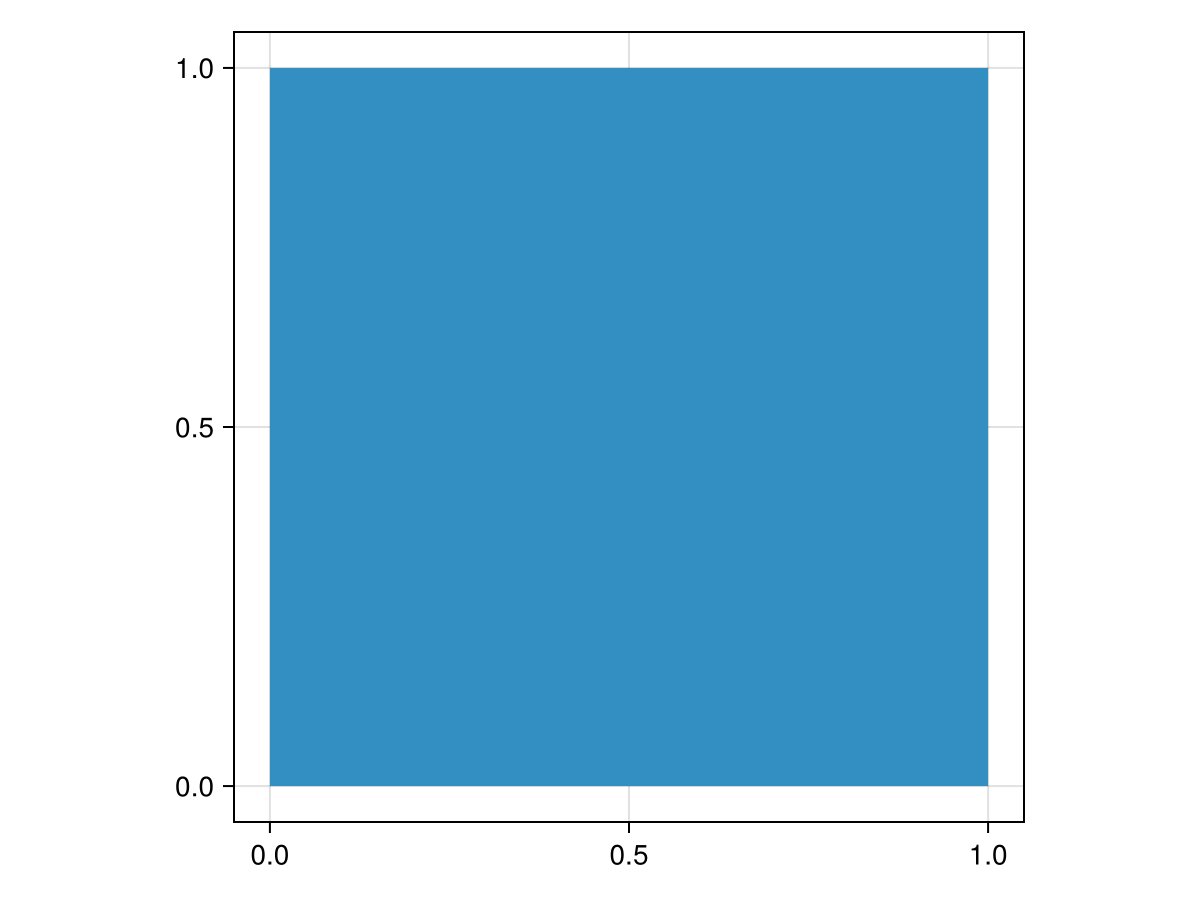
This is clearly a rectangle, etc. But now let's look at how the points look:
lines!(
    collect(GI.getpoint(rect));
    color = 1:GI.npoint(rect), linewidth = 10.0)
f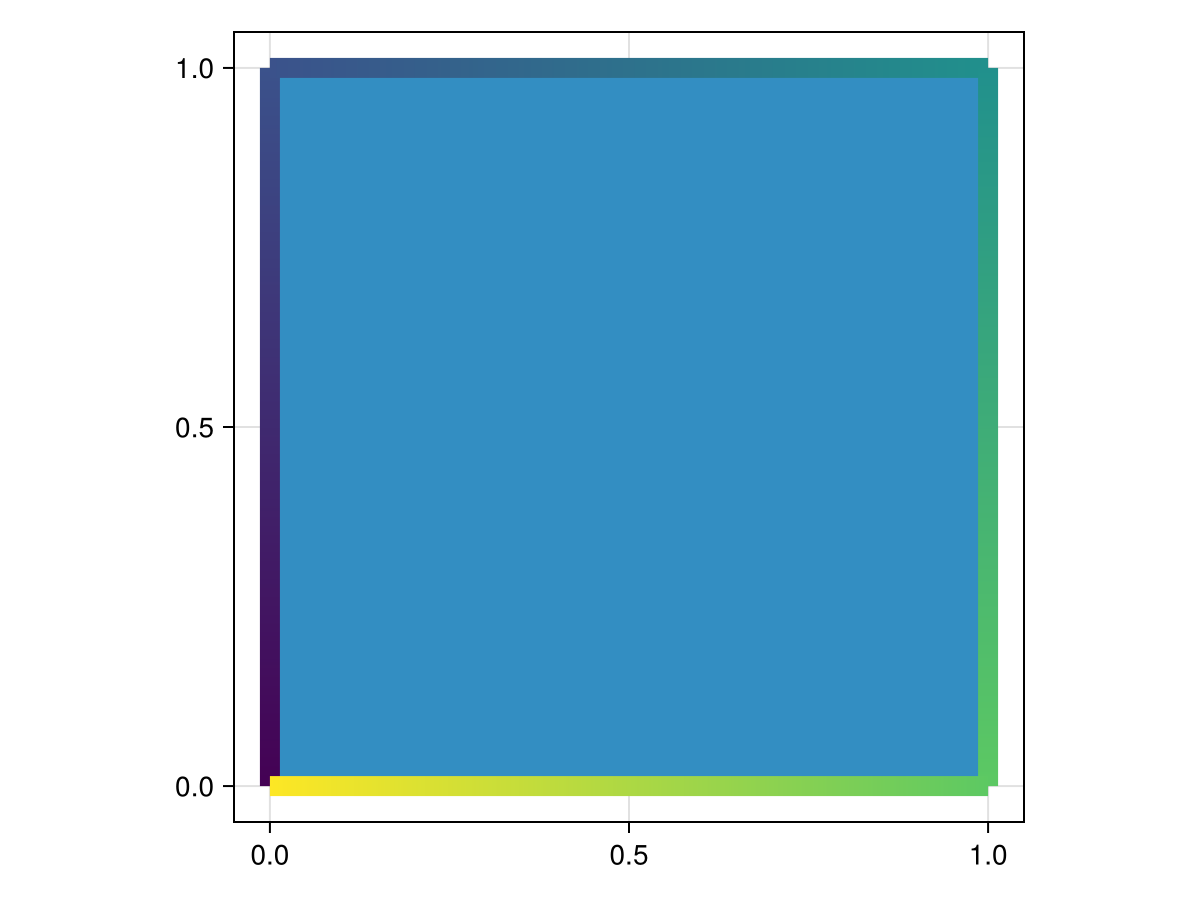
The points are ordered in a counterclockwise fashion, which means that the signed area is negative. If we reverse the order of the points, we get a positive area.
GO.signed_area(rect) # -1.0-1.0Implementation
This is the GeoInterface-compatible implementation. First, we implement a wrapper method that dispatches to the correct implementation based on the geometry trait. This is also used in the implementation, since it's a lot less work!
Note that area and signed area are zero for all points and curves, even if the curves are closed like with a linear ring. Also note that signed area really only makes sense for polygons, given with a multipolygon can have several polygons each with a different orientation and thus the absolute value of the signed area might not be the area. This is why signed area is only implemented for polygons.
Targets for applys functions
const _AREA_TARGETS = TraitTarget{Union{GI.PolygonTrait,GI.AbstractCurveTrait,GI.MultiPointTrait,GI.PointTrait}}()

"""
    area(geom, [T = Float64])::T
    area(manifold::Manifold, geom, [T = Float64])::T
    area(algorithm::Algorithm, geom, [T = Float64])::T

Returns the area of a geometry or collection of geometries.
This is computed slightly differently for different geometries:

    - The area of a point/multipoint is always zero.
    - The area of a curve/multicurve is always zero.
    - The area of a polygon is the absolute value of the signed area.
    - The area multi-polygon is the sum of the areas of all of the sub-polygons.
    - The area of a geometry collection, feature collection of array/iterable
        is the sum of the areas of all of the sub-geometries.

# Manifold support

- `AutoManifold()` (default): When the Proj extension is loaded, recognized
  geographic CRSs use a geodesic calculation on the CRS ellipsoid and
  recognized projected CRSs use native-unit `Planar()` calculations. Without
  Proj, geographic geometries use degree-based `Spherical()` calculations,
  while projected and unknown geometries use native-unit `Planar()` calculations.
  The manifold is selected once from the top-level input's CRS and applies to
  all geometries contained in that input.
- `Planar()`: Uses the shoelace formula in native coordinate units squared,
  regardless of CRS.
- `Spherical()`: Uses Girard's theorem for spherical polygons. Coordinates
   are interpreted as (longitude, latitude) in degrees. Returns area in
   square units of the sphere's radius (default: Earth's mean radius in meters).
- `Geodesic()`: Uses geodesic calculations (requires Proj extension).

Projected map area is a planar grid measurement and can differ from surface
area, particularly for projections with distortion.

# Examples

```julia
import GeometryOps as GO
import GeoInterface as GI
CRS-free planar area (the AutoManifold default)
rect = GI.Polygon([[(0,0), (1,0), (1,1), (0,1), (0,0)]])
GO.area(rect)  # 1.0
Spherical area (1/8 of Earth's surface)
octant = GI.Polygon([[(0.0, 0.0), (90.0, 0.0), (0.0, 90.0), (0.0, 0.0)]])
GO.area(GO.Spherical(), octant)  # ≈ 6.38e13 m²
Spherical area with custom radius (unit sphere)
GO.area(GO.Spherical(radius=1.0), octant)  # ≈ π/2
```

Result will be of type T, where T is an optional argument with a default value
of Float64.
"""
function area(geom, ::Type{T} = Float64; threaded=false, kwargs...) where T <: AbstractFloat
    area(AutoManifold(), geom, T; threaded, kwargs...)
end

function area(::AutoManifold, geom, ::Type{T} = Float64; threaded=false, kwargs...) where T <: AbstractFloat
    _area_auto(GI.crstrait(geom), GI.crs(geom), geom, T; threaded, kwargs...)
end

function _area_auto(trait::GI.AbstractCRSTrait, crs, geom, ::Type{T}; threaded=false, kwargs...) where T
    isnothing(crs) && return area(Planar(), geom, T; threaded, kwargs...)
    _area_auto_with_crs(trait, crs, geom, T; threaded, kwargs...)
end
Without Proj, GeoInterface's geographic trait is the only signal to interpret coordinates as lon/lat.
_area_auto_with_crs(::GI.AbstractGeographicTrait, crs, geom, ::Type{T}; threaded=false, kwargs...) where T =
    area(Spherical(), geom, T; threaded, kwargs...)
A projected CRS has map-plane coordinates; preserve their native square units without Proj.
_area_auto_with_crs(::GI.AbstractProjectedTrait, crs, geom, ::Type{T}; threaded=false, kwargs...) where T =
    area(Planar(), geom, T; threaded, kwargs...)

function area(::Planar, geom, ::Type{T} = Float64; threaded=false, kwargs...) where T <: AbstractFloat
    applyreduce(WithTrait((trait, g) -> _area(T, trait, g)), +, _AREA_TARGETS, geom; threaded, init=zero(T), kwargs...)
end

"""
    signed_area(geom, [T = Float64])::T

Returns the signed area of a single geometry, based on winding order.
This is computed slightly differently for different geometries:

    - The signed area of a point is always zero.
    - The signed area of a curve is always zero.
    - The signed area of a polygon is computed with the shoelace formula and is
    positive if the polygon coordinates wind clockwise and negative if
    counterclockwise.
    - You cannot compute the signed area of a multipolygon as it doesn't have a
    meaning as each sub-polygon could have a different winding order.

Result will be of type T, where T is an optional argument with a default value
of Float64.
"""
signed_area(geom, ::Type{T} = Float64) where T <: AbstractFloat =
    _signed_area(T, GI.trait(geom), geom)
Points, MultiPoints, Curves, MultiCurves
_area(::Type{T}, ::GI.AbstractGeometryTrait, geom) where T = zero(T)

_signed_area(::Type{T}, ::GI.AbstractGeometryTrait, geom) where T = zero(T)
LibGEOS treats linear rings as zero area. I disagree with that but we should probably maintain compatibility...
_area(::Type{T}, tr::GI.LinearRingTrait, geom) where T = 0 # could be abs(_signed_area(T, tr, geom))

_signed_area(::Type{T}, ::GI.LinearRingTrait, geom) where T = 0 # could be _signed_area(T, tr, geom)
Polygons
_area(::Type{T}, trait::GI.PolygonTrait, poly) where T =
    abs(_signed_area(T, trait, poly))

function _signed_area(::Type{T}, ::GI.PolygonTrait, poly) where T
    GI.isempty(poly) && return zero(T)
    s_area = _signed_area(T, GI.getexterior(poly))
    area = abs(s_area)
    area == 0 && return area
Remove hole areas from total
    for hole in GI.gethole(poly)
        area -= abs(_signed_area(T, hole))
    end
Winding of exterior ring determines sign
    return area * sign(s_area)
end
One term of the shoelace area formula
_area_component(p1, p2) = GI.x(p1) * GI.y(p2) - GI.y(p1) * GI.x(p2)

#= Calculates the signed area of a given curve. This is equivalent to integrating
to find the area under the curve. Even if curve isn't explicitly closed by
repeating the first point at the end of the coordinates, curve is still assumed
to be closed. =#
function _signed_area(::Type{T}, geom) where T
    area = zero(T)
    np = GI.npoint(geom)
    np == 0 && return area

    first = true
    local pfirst, p1
Integrate the area under the curve
for p2 in GI.getpoint(geom)Skip the first and do it later This lets us work within one iteration over geom, which means on C call when using points from external libraries.
        if first
            p1 = pfirst = p2
            first = false
            continue
        end
Accumulate the area into area
        area += _area_component(p1, p2)
        p1 = p2
    end
Complete the last edge. If the first and last where the same this will be zero
    p2 = pfirst
    area += _area_component(p1, p2)
    return T(area / 2)
end
Spherical Area
The first implementation here is a naive triangulated implementation. The second cut implementation that is planned will use the algorithm that Google's s2 uses to get numerically stable triangles from a spherical polygon.
export NaiveTriangulatedSphericalArea

abstract type SphericalTriangleAreaMethod end

struct Girard <: SphericalTriangleAreaMethod end
struct Eriksson <: SphericalTriangleAreaMethod end
struct NaiveTriangulatedSphericalArea{S <: Spherical, T <: SphericalTriangleAreaMethod} <: SingleManifoldAlgorithm{S}
    manifold::S
    method::T
end
NaiveTriangulatedSphericalArea(; radius = Spherical().radius, method = Eriksson()) = NaiveTriangulatedSphericalArea(Spherical(; radius), method)
NaiveTriangulatedSphericalArea(manifold::Spherical) = NaiveTriangulatedSphericalArea(manifold, Eriksson())
GeometryOpsCore.manifold(alg::NaiveTriangulatedSphericalArea) = alg.manifold

using .UnitSpherical: UnitSphericalPoint
Compute signed area of a spherical triangle on the unit sphere using the half-angle formula. Returns the spherical excess E, which equals the area on the unit sphere.
function _spherical_triangle_area(::Girard, p1::UnitSphericalPoint, p2::UnitSphericalPoint, p3::UnitSphericalPoint)
    cross_23 = p2 × p3
    triple = p1 ⋅ cross_23
    d12 = p1 ⋅ p2
    d23 = p2 ⋅ p3
    d31 = p3 ⋅ p1
    denom = 1 + d12 + d23 + d31
    abs(denom) < eps(Float64) && return zero(Float64)
    return 2 * atan(triple, denom)
end
Using Eriksson's formula for the area of spherical triangles: https://www.jstor.org/stable/2691141 This is the Van Oosterom–Strackee tangent-half-angle form, kept natively SIGNED so that reflex triangles in a fan triangulation subtract (concave rings) instead of adding. numerator is the raw signed triple product a ⋅ (b × c); denominator is 1 + a⋅b + b⋅c + c⋅a. The (b - a, c - a) / (b + a, c + a) rewrites are algebraically identical to the commented lines below but better conditioned for tiny triangles (Eriksson 1990), so small-polygon accuracy is preserved. atan2 also branches correctly when denominator ≤ 0 (large fan triangles whose true |area| exceeds π), which atan(abs(t)) cannot represent.
function _spherical_triangle_area(::Eriksson, a::UnitSphericalPoint, b::UnitSphericalPoint, c::UnitSphericalPoint)
    #numerator = dot(a, cross(b, c))
    #denominator = 1 + dot(b,c) + dot(c, a) + dot(a, b)
    numerator = dot(a, (cross(b - a, c - a)))
    denominator = dot(b + a, c + a)
    return 2 * atan(numerator, denominator)
end
Compute signed area of a ring using streaming iteration (no allocation)
function _naive_triangulated_spherical_ring_area(method::SphericalTriangleAreaMethod, trait::GI.AbstractCurveTrait, ring, T)
    GI.npoint(trait, ring) < 3 && return zero(T)
Get first point and remaining points
    p1_geo, rest = Iterators.peel(GI.getpoint(trait, ring))
    p1 = UnitSphericalPoint(GI.PointTrait(), p1_geo)
    pfirst = p1
Collect remaining points, converting to unit sphere
    points = collect(Iterators.map(p -> UnitSphericalPoint(GI.PointTrait(), p), rest))
    isempty(points) && return zero(T)
Skip closing point if it matches first
    if points[end] ≈ pfirst
        pop!(points)
    end
    length(points) < 2 && return zero(T)
Triangulate from first vertex
    area = zero(T)
    for i in 1:(length(points)-1)
        area += _spherical_triangle_area(method, pfirst, points[i], points[i+1])
    end
    return area
end
Dispatch area(::Spherical, ...) to use NaiveTriangulatedSphericalArea with Eriksson's formula for triangles
function area(m::Spherical, geom, ::Type{T} = Float64; threaded=false, kwargs...) where T <: AbstractFloat
    area(NaiveTriangulatedSphericalArea(m), geom, T; threaded, kwargs...)
end
Compute the area of a single polygon (exterior minus holes) on the unit sphere. These must be top-level functions: a multi-method local function captured by a closure gets lowered into a Core.Box, making area infer as Any. See https://github.com/JuliaGeo/GeometryOps.jl/issues/407.
function _naive_triangulated_spherical_polygon_area(method::SphericalTriangleAreaMethod, ::Type{T}, ::GI.PolygonTrait, poly) where T
    GI.isempty(poly) && return zero(T)
    ext = GI.getexterior(poly)
    ext_area = abs(_naive_triangulated_spherical_ring_area(method, GI.trait(ext), ext, T))
    for hole in GI.gethole(poly)
        hole_trait = GI.trait(hole)
        ext_area -= abs(_naive_triangulated_spherical_ring_area(method, hole_trait, hole, T))
    end
    return ext_area
end
_naive_triangulated_spherical_polygon_area(::SphericalTriangleAreaMethod, ::Type{T}, ::GI.PointTrait, point) where T = zero(T)
Ring area over a plain vector of points
intersection_area measures the rings a clipping engine produced without wrapping them in a geometry first, so these take a vector of points. closed says whether that vector repeats its first point at the end — the caller knows, and it cannot be re-derived here: the two ends of a sliver ring are legitimately close together, and no tolerance can tell that apart from a closing point.
They must stay term-for-term equivalent to _signed_area and _naive_triangulated_spherical_ring_area above: that equality is exactly what makes intersection_area(alg, a, b) and area(manifold(alg), intersection(alg, a, b)) agree to the last bit. Change a formula there, change it here.
Shoelace, wrapping from the last point to the first. A repeated closing point contributes a zero term, so closed and open rings both work.
function _ring_area(::Planar, pts::AbstractVector, ::Type{T}; closed::Bool = true) where T
    n = length(pts)
    n < 3 && return zero(T)
    area = zero(T)
    for i in 1:n
        area += _area_component(pts[i], pts[mod1(i + 1, n)])
    end
    return T(area / 2)
end
Signed unit-sphere area, by the same fan triangulation from the first vertex.
function _ring_area(::Spherical, pts::AbstractVector, ::Type{T}; closed::Bool = true) where T
    n = length(pts)
    n < 3 && return zero(T)
p1 = UnitSphericalPoint(GI.PointTrait(), pts[1]) closed && UnitSphericalPoint(GI.PointTrait(), pts[n]) ≈ p1 && (n -= 1)
n < 3 && return zero(T)
area = zero(T)
for i in 2:(n - 1)
area += _spherical_triangle_area(Eriksson(), p1,
UnitSphericalPoint(GI.PointTrait(), pts[i]), UnitSphericalPoint(GI.PointTrait(), pts[i + 1]))
end
return T(area)
endThe factor an area on the unit sphere is scaled by to reach the manifold's own units.
_area_scale(::Planar) = 1
_area_scale(m::Spherical) = m.radius^2
Main implementation for NaiveTriangulatedSphericalArea
function area(alg::NaiveTriangulatedSphericalArea, geom, ::Type{T} = Float64; threaded=false, kwargs...) where T <: AbstractFloat
    unit_area = applyreduce(
        WithTrait((trait, g) -> _naive_triangulated_spherical_polygon_area(alg.method, T, trait, g)),
        +,
        TraitTarget{Union{GI.PolygonTrait, GI.PointTrait}}(),
        geom;
        threaded,
        init=zero(T),
        kwargs...
    )
    return T(unit_area * manifold(alg).radius^2)
end
This page was generated using Literate.jl.