NOTE: This functionality is experimental and may change at any time.
Relate
export relate, RelateNG, prepareWhat is relate?
The relate function computes the full topological relationship between two geometries — not just a single yes/no question like intersects or within, but the complete description from which every such question can be answered. That description is the dimensionally extended nine-intersection model (DE-9IM) matrix.
To provide an example, consider these two overlapping polygons:
import GeometryOps as GO
import GeoInterface as GI
using Makie
using CairoMakie

p1 = GI.Polygon([[(0.0, 0.0), (3.0, 0.0), (3.0, 3.0), (0.0, 3.0), (0.0, 0.0)]])
p2 = GI.Polygon([[(2.0, 2.0), (5.0, 2.0), (5.0, 5.0), (2.0, 5.0), (2.0, 2.0)]])
f, a, p = poly(collect(GI.getpoint(p1)); color = (:blue, 0.5), axis = (; aspect = DataAspect()))
poly!(collect(GI.getpoint(p2)); color = (:orange, 0.5))
f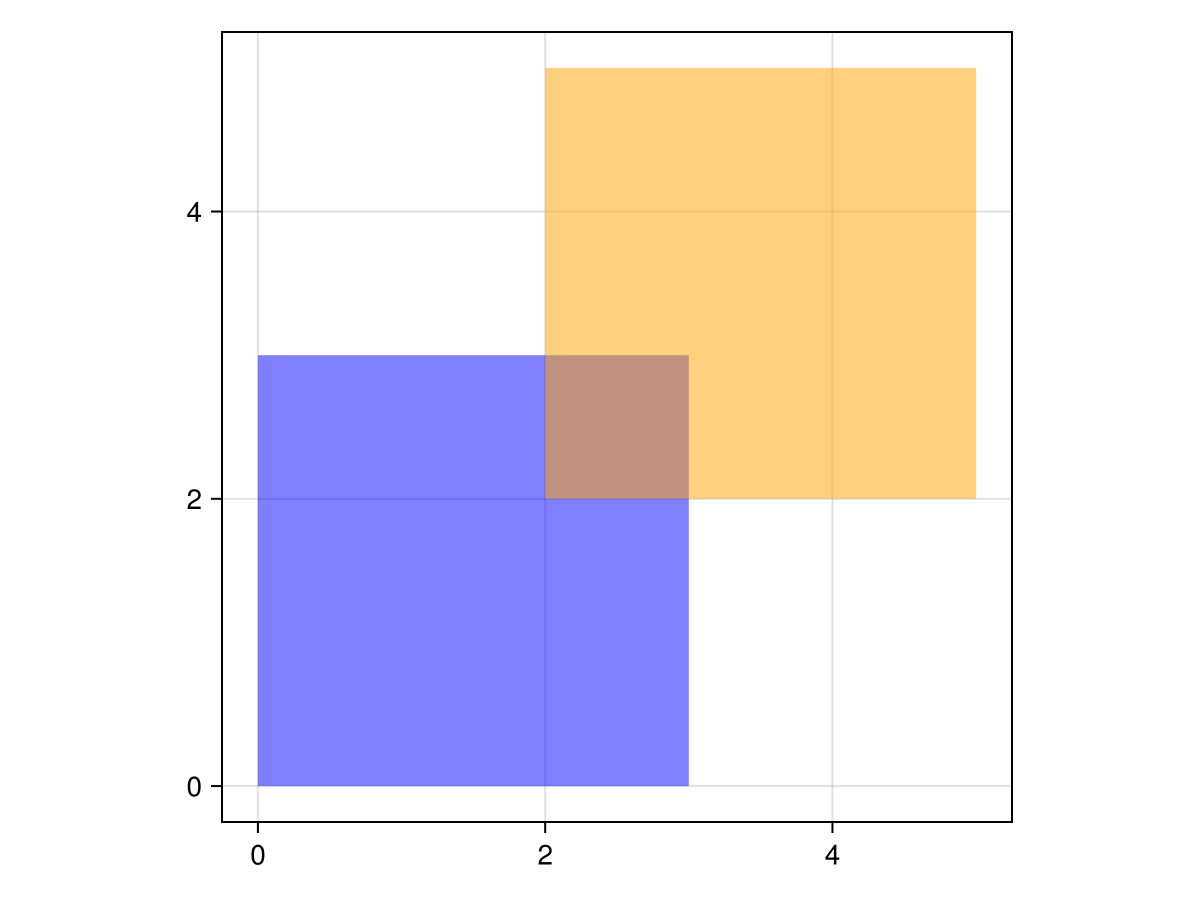
Their relationship is captured by a single matrix:
GO.relate(p1, p2)DE9IM("212101212")What is the DE-9IM?
Every geometry partitions the plane into three point sets: its interior, its boundary, and its exterior. The DE-9IM matrix records, for each of the nine pairings of those sets between geometry A (rows) and geometry B (columns), the dimension of the pair's intersection: F for empty, 0 for points, 1 for lines, 2 for areas. The matrix above, "212101212", reads row-major:
| B interior | B boundary | B exterior | |
|---|---|---|---|
| A interior | 2 | 1 | 2 |
| A boundary | 1 | 0 | 1 |
| A exterior | 2 | 1 | 2 |
The interiors meet in an area (2), the boundaries cross at points (0), and each geometry has interior outside the other (2 in the exterior column/row) — exactly the overlaps relationship. Named predicates are just patterns over this matrix, where T means "non-empty (any dimension)" and * means "don't care". You can match a pattern directly, which short-circuits as soon as the answer is known instead of computing the full matrix:
GO.relate(p1, p2, "T*T***T**") # the `overlaps` pattern for two areastrueor evaluate a named predicate through the RelateNG algorithm:
GO.overlaps(GO.RelateNG(), p1, p2)trueWhen one geometry is tested against many others, prepare it once and reuse the cached indexes:
prep = GO.prepare(GO.RelateNG(), p1)
GO.relate(prep, p2)DE9IM("212101212")Implementation
This file is the port of JTS RelateNG.java — the evaluation engine that drives all the RelateNG machinery (the kernel, point locators, topology computer, and node analysis in the surrounding files) to compute the value of a topological predicate between two geometries, based on the DE-9IM model.
Method order parallels the Java file (evaluate, hasRequiredEnvelopeInteraction, finishValue, computePP, computeAtPoints, computePoints, computePoint, computeLineEnds, computeLineEnd, computeAreaVertex ×2, computeAtEdges, computeEdgesAll, computeEdgesMutual), so this file diffs against its Java counterpart. Idiom changes:
The Java class holds
geomA(for prepared mode); here the unprepared entry points build bothRelateGeometrys per call, while prepared mode carries the A side — with its lazy caches forced and the segment strings/segment tree prebuilt — in aPreparedRelate, threaded through the evaluation as the optionalprepargument.The algorithm configuration (manifold, accelerator, exactness flag, boundary node rule) travels in the
RelateNGalgorithm struct, the houseAlgorithm{M}idiom (cf.FosterHormannClipping).Java's
computeEdgesAllfeeds the combined A∪B edge set through oneEdgeSetIntersector(every unordered chain pair once). Here that is phased as A×B (process_edge_intersections!), then A×A and B×B (process_self_intersections!) — the same pair set, possibly visited in a different order, which only affects when a short-circuiting predicate exits, never the final value (dimension updates are monotone).Java's null
Envelopeisnothinghere: empty geometries have anothingextent,ext_intersects/ext_coversreturnfalsefor it (as Java's null envelope does), andcomputeAtEdgesearly-returns before ever forwarding an extent filter that could benothing.
"""
    RelateNG{M <: Manifold, A <: IntersectionAccelerator, E, BR <: BoundaryNodeRule}

This functionality is experimental and may change at any time.

The next-generation DE-9IM topological-relationship algorithm, a port of the
JTS RelateNG algorithm by Martin Davis. Capabilities:

1. Efficient short-circuited evaluation of topological predicates (including
   matching custom DE-9IM matrix patterns).
2. Robust evaluation: all answers are computed from exact predicates on the
   input coordinates (no constructed intersection points), so invalid
   topology does not cause failures.
3. `GeometryCollection` inputs containing mixed types and overlapping
   polygons are supported, using *union semantics*.
4. Zero-length LineStrings are treated as being topologically identical to
   Points.
5. Support for `BoundaryNodeRule`s.

All coordinates are evaluated as `Float64`: input coordinates are converted
on extraction, and the exact-predicate machinery (adaptive orientation
predicates, rational-arithmetic node coincidence) assumes `Float64` inputs.
Non-`Float64` geometries are accepted but evaluated at `Float64` precision.

Keyword arguments (all optional): `manifold` (default `Planar()`),
`accelerator` (default `AutoAccelerator`), `exact` (default
`True()`), `boundary_rule` (default `Mod2Boundary`, the OGC SFS
rule).

# Unprepared performance

Every unprepared evaluation rebuilds an extent-annotated view of both
inputs (the stand-in for the envelope cache JTS keeps on each Geometry),
one coordinate pass per call. Inputs that already carry extents at every
level skip that pass — stamp them once with

```julia
geom = GO.tuples(geom; calc_extent = true)
```

and repeated unprepared calls read the stored extents instead. When one
geometry is queried many times, `prepare` it instead: the prepared
form also caches the point locators and edge index.

See `relate` and `relate_predicate` for the entry points.
"""
struct RelateNG{M <: Manifold, A <: IntersectionAccelerator, E, BR <: BoundaryNodeRule} <: GeometryOpsCore.Algorithm{M}
    manifold::M
    accelerator::A
    exact::E
    boundary_rule::BR
end
RelateNG(; manifold::Manifold = Planar(), accelerator = AutoAccelerator(),
        exact = True(), boundary_rule = Mod2Boundary()) =
    RelateNG(manifold, accelerator, exact, boundary_rule)
RelateNG(m::Manifold; kw...) = RelateNG(; manifold = m, kw...)
GeometryOpsCore.manifold(alg::RelateNG) = alg.manifold
Entry points (the static RelateNG.relate(...) overloads)
"""
    relate([alg::RelateNG], a, b)::DE9IM

This functionality is experimental and may change at any time.

Computes the `DE9IM` matrix for the topological relationship between
geometries `a` and `b`.

Port of `RelateNG.relate(Geometry, Geometry)`.
"""
function relate(alg::RelateNG, a, b)
    pred = RelateMatrixPredicate()
    relate_predicate(alg, pred, a, b)
    return result_im(pred)
end
relate(a, b) = relate(RelateNG(), a, b)

"""
    relate([alg::RelateNG], a, b, im_pattern::AbstractString)::Bool

This functionality is experimental and may change at any time.

Tests whether the topological relationship between geometries `a` and `b`
matches the DE-9IM matrix pattern `im_pattern` (9 characters over
`012TF*`).

Port of `RelateNG.relate(Geometry, Geometry, String)`.
"""
relate(alg::RelateNG, a, b, im_pattern::AbstractString) =
    relate_predicate(alg, pred_matches(im_pattern), a, b)
relate(a, b, im_pattern::AbstractString) = relate(RelateNG(), a, b, im_pattern)
Method-ambiguity guard between relate(alg, a, b) and relate(a, b, pattern): a String third argument with a RelateNG first argument is missing its B geometry.
relate(alg::RelateNG, a, im_pattern::AbstractString) =
    throw(ArgumentError("`relate(alg, a, b, pattern)` requires both geometries; got a pattern in place of the B geometry"))

"""
    relate_predicate(alg::RelateNG, predicate::TopologyPredicate, a, b)::Bool

This functionality is experimental and may change at any time.

Tests whether the topological relationship between geometries `a` and `b`
satisfies the given `TopologyPredicate`. This is the core evaluation
entry point (the port of `RelateNG.evaluate(Geometry, TopologyPredicate)`,
via the static `RelateNG.relate(a, b, pred)`).

!!! note
    Predicates are mutable accumulators — pass a freshly constructed one
    (e.g. `pred_intersects()`) per evaluation.
"""
function relate_predicate(alg::RelateNG, predicate::TopologyPredicate, a, b)
    m = GeometryOpsCore.manifold(alg)
    geom_a = RelateGeometry(m, a; exact = alg.exact, boundary_rule = alg.boundary_rule)
    return evaluate!(alg, geom_a, b, predicate)
end
Named-predicate methods
The ports of the JTS RelateNG static predicate overloads. These add RelateNG algorithm methods to the existing GO predicate functions, following the house GO.f(alg::Algorithm, a, b) idiom (cf. GO.intersects(GO.GEOS(), a, b) in the LibGEOS extension). They are opt-in: the two-argument forms GO.intersects(a, b) etc. keep dispatching to the old engines (design D4).
equals maps to pred_equalstopo, i.e. topological equality (the DE-9IM T*F**FFF* sense), which can differ from the structural equality the two-argument GO.equals implements only in exotic cases (both treat rotated/reversed rings and repeated points as equal).
These rebuild the A side on every call; pass a prepared g1 to reuse it instead.
"This functionality is experimental and may change at any time."
intersects(alg::RelateNG, g1, g2) = relate_predicate(alg, pred_intersects(), g1, g2)
"This functionality is experimental and may change at any time."
disjoint(alg::RelateNG, g1, g2)   = relate_predicate(alg, pred_disjoint(), g1, g2)
"This functionality is experimental and may change at any time."
contains(alg::RelateNG, g1, g2)   = relate_predicate(alg, pred_contains(), g1, g2)
"This functionality is experimental and may change at any time."
within(alg::RelateNG, g1, g2)     = relate_predicate(alg, pred_within(), g1, g2)
"This functionality is experimental and may change at any time."
covers(alg::RelateNG, g1, g2)     = relate_predicate(alg, pred_covers(), g1, g2)
"This functionality is experimental and may change at any time."
coveredby(alg::RelateNG, g1, g2)  = relate_predicate(alg, pred_coveredby(), g1, g2)
"This functionality is experimental and may change at any time."
crosses(alg::RelateNG, g1, g2)    = relate_predicate(alg, pred_crosses(), g1, g2)
"This functionality is experimental and may change at any time."
overlaps(alg::RelateNG, g1, g2)   = relate_predicate(alg, pred_overlaps(), g1, g2)
"This functionality is experimental and may change at any time."
touches(alg::RelateNG, g1, g2)    = relate_predicate(alg, pred_touches(), g1, g2)
"This functionality is experimental and may change at any time."
equals(alg::RelateNG, g1, g2)     = relate_predicate(alg, pred_equalstopo(), g1, g2)
Evaluation (port of RelateNG.evaluate and helpers)
Port of RelateNG.evaluate(Geometry b, TopologyPredicate predicate): the phased evaluation against a prebuilt A-side RelateGeometry. In prepared mode prep is the PreparedRelate carrying the cached A-side edges/index; otherwise nothing.
function evaluate!(alg::RelateNG, geom_a::RelateGeometry, b, predicate::TopologyPredicate,
prep = nothing) geom_b = RelateGeometry(geom_a.m, b; exact = geom_a.exact,
boundary_rule = geom_a.boundary_rule)
if !has_required_envelope_interaction(geom_a, get_extent(geom_b), predicate)
return false
end
dim_a = get_dimension_real(geom_a)
dim_b = get_dimension_real(geom_b) init_dims!(predicate, dim_a, dim_b)
is_known(predicate) && return finish_value!(predicate)
init_bounds!(predicate, get_extent(geom_a), get_extent(geom_b))
is_known(predicate) && return finish_value!(predicate)
tc = TopologyComputer(predicate, geom_a, geom_b) if dim_a == DIM_P && dim_b == DIM_P
compute_pp!(tc, geom_a, geom_b)
    finish!(tc)
    return get_result(tc)
end compute_at_points!(tc, geom_b, GEOM_B, geom_a)
is_result_known(tc) && return get_result(tc)
compute_at_points!(tc, geom_a, GEOM_A, geom_b)
is_result_known(tc) && return get_result(tc)
if has_edges(geom_a) && has_edges(geom_b)
compute_at_edges!(alg, tc, geom_a, geom_b, prep)
end finish!(tc)
return get_result(tc)
endPort of RelateNG.hasRequiredEnvelopeInteraction (private). env_b is the B extent computed directly from the raw geometry by the caller, as Java reads b.getEnvelopeInternal() before constructing the B RelateGeometry; an empty geometry yields a nothing (null) extent, for which ext_covers/ ext_intersects return false, exactly like Java's null Envelope.
function has_required_envelope_interaction(geom_a::RelateGeometry, env_b, predicate::TopologyPredicate)
    is_interacts = false
    if require_covers(predicate, GEOM_A)
        if !ext_covers(get_extent(geom_a), env_b)
            return false
        end
        is_interacts = true
    elseif require_covers(predicate, GEOM_B)
        if !ext_covers(env_b, get_extent(geom_a))
            return false
        end
        is_interacts = true
    end
    if !is_interacts &&
            require_interaction(predicate) &&
            !ext_intersects(get_extent(geom_a), env_b)
        return false
    end
    return true
end
Port of RelateNG.finishValue (private).
function finish_value!(predicate::TopologyPredicate)
    finish!(predicate)
    return predicate_value(predicate)
end
Port of RelateNG.computePP (private): an optimized algorithm for evaluating P/P cases. It tests one point set against the other.
function compute_pp!(tc::TopologyComputer, geom_a::RelateGeometry, geom_b::RelateGeometry)
    pts_a = get_unique_points(geom_a)
    #TODO: only query points in interaction extent?
    pts_b = get_unique_points(geom_b)

    num_b_in_a = 0
    for pt_b in pts_b
        if pt_b in pts_a
            num_b_in_a += 1
            add_point_on_point_interior!(tc, pt_b)
        else
            add_point_on_point_exterior!(tc, GEOM_B, pt_b)
        end
        is_result_known(tc) && return nothing
    end
    #=
    If number of matched B points is less than size of A,
    there must be at least one A point in the exterior of B
    =#
    if num_b_in_a < length(pts_a)
        #TODO: determine actual exterior point?
        add_point_on_point_exterior!(tc, GEOM_A, nothing)
    end
    return nothing
end
Port of RelateNG.computeAtPoints (private).
function compute_at_points!(tc::TopologyComputer, geom::RelateGeometry, is_a::Bool,
        geom_target::RelateGeometry)
    is_result_known_ = compute_points!(tc, geom, is_a, geom_target)
    is_result_known_ && return nothing

    #=
    Performance optimization: only check points against target
    if it has areas OR if the predicate requires checking for
    exterior interaction.
    In particular, this avoids testing line ends against lines
    for the intersects predicate (since these are checked
    during segment/segment intersection checking anyway).
    Checking points against areas is necessary, since the input
    linework is disjoint if one input lies wholly inside an area,
    so segment intersection checking is not sufficient.
    =#
    check_disjoint_points = has_dimension(geom_target, DIM_A) ||
        is_exterior_check_required(tc, is_a)
    check_disjoint_points || return nothing

    is_result_known_ = compute_line_ends!(tc, geom, is_a, geom_target)
    is_result_known_ && return nothing

    compute_area_vertex!(tc, geom, is_a, geom_target)
    return nothing
end
Port of RelateNG.computePoints (private).
function compute_points!(tc::TopologyComputer, geom::RelateGeometry, is_a::Bool,
        geom_target::RelateGeometry)
    has_dimension(geom, DIM_P) || return false

    points = get_effective_points(geom)
    for point in points
        #TODO: exit when all possible target locations (E,I,B) have been found?
        GI.isempty(point) && continue

        pt = _to_kernel_point(geom.m, point)
        compute_point!(tc, is_a, pt, geom_target)
        is_result_known(tc) && return true
    end
    return false
end
Port of RelateNG.computePoint (private).
function compute_point!(tc::TopologyComputer, is_a::Bool, pt, geom_target::RelateGeometry)
    loc_dim_target = locate_with_dim(geom_target, pt)
    loc_target = dimloc_location(loc_dim_target)
    dim_target = dimloc_dimension(loc_dim_target, get_dimension(tc, !is_a))
    add_point_on_geometry!(tc, is_a, loc_target, dim_target, pt)
    return nothing
end
Port of RelateNG.computeLineEnds (private). The Java GeometryCollectionIterator + instanceof LineString filter becomes a recursive walk over atomic curve elements; the walk threads the hasExteriorIntersection flag and reports early exit through its first return value.
function compute_line_ends!(tc::TopologyComputer, geom::RelateGeometry, is_a::Bool,
        geom_target::RelateGeometry)
    has_dimension(geom, DIM_L) || return false
    done, _ = _compute_line_ends_walk!(tc, geom.geom, geom, is_a, geom_target, false)
    return done
end

function _compute_line_ends_walk!(tc::TopologyComputer, elem, geom::RelateGeometry,
        is_a::Bool, geom_target::RelateGeometry, has_exterior_intersection::Bool)
    trait = GI.trait(elem)
    if trait isa GI.AbstractGeometryCollectionTrait
        for g in GI.getgeom(elem)
            done, has_exterior_intersection = _compute_line_ends_walk!(
                tc, g, geom, is_a, geom_target, has_exterior_intersection)
            done && return (true, has_exterior_intersection)
        end
        return (false, has_exterior_intersection)
    end
    trait isa GI.AbstractCurveTrait || return (false, has_exterior_intersection)
GI.isempty(elem) && return (false, has_exterior_intersection) if has_exterior_intersection && _elem_env_disjoint(geom.m, elem, get_extent(geom_target))
return (false, has_exterior_intersection)
end
e0 = _to_kernel_point(geom.m, GI.getpoint(elem, 1))
has_exterior_intersection |= compute_line_end!(tc, geom, is_a, e0, geom_target)
is_result_known(tc) && return (true, has_exterior_intersection)
if !_line_is_closed(elem)
e1 = _to_kernel_point(geom.m, GI.getpoint(elem, GI.npoint(elem)))
has_exterior_intersection |= compute_line_end!(tc, geom, is_a, e1, geom_target)
is_result_known(tc) && return (true, has_exterior_intersection)
end
#TODO: break when all possible locations have been found?
return (false, has_exterior_intersection)
endPort of RelateNG.computeLineEnd (private): compute the topology of a line endpoint. Also reports if the line end is in the exterior of the target geometry, to optimize testing multiple exterior endpoints.
function compute_line_end!(tc::TopologyComputer, geom::RelateGeometry, is_a::Bool, pt,
        geom_target::RelateGeometry)
    loc_dim_line_end = locate_line_end_with_dim(geom, pt)
dim_line_end = dimloc_dimension(loc_dim_line_end, get_dimension(tc, is_a)) dim_line_end != DIM_L && return false
loc_line_end = dimloc_location(loc_dim_line_end)
loc_dim_target = locate_with_dim(geom_target, pt)
loc_target = dimloc_location(loc_dim_target)
dim_target = dimloc_dimension(loc_dim_target, get_dimension(tc, !is_a))
add_line_end_on_geometry!(tc, is_a, loc_line_end, loc_target, dim_target, pt)
return loc_target == LOC_EXTERIOR
endPort of RelateNG.computeAreaVertex(geom, isA, geomTarget, topoComputer) (private): the recursive walk over atomic polygon elements.
function compute_area_vertex!(tc::TopologyComputer, geom::RelateGeometry, is_a::Bool,
        geom_target::RelateGeometry)
has_dimension(geom, DIM_A) || return false get_dimension(geom_target) < DIM_L && return false
done, _ = _compute_area_vertex_walk!(tc, geom.geom, geom, is_a, geom_target, false)
return done
end
function _compute_area_vertex_walk!(tc::TopologyComputer, elem, geom::RelateGeometry,
is_a::Bool, geom_target::RelateGeometry, has_exterior_intersection::Bool)
trait = GI.trait(elem)
if trait isa GI.AbstractGeometryCollectionTrait
for g in GI.getgeom(elem)
done, has_exterior_intersection = _compute_area_vertex_walk!(
tc, g, geom, is_a, geom_target, has_exterior_intersection)
done && return (true, has_exterior_intersection)
end
return (false, has_exterior_intersection)
end
trait isa GI.AbstractPolygonTrait || return (false, has_exterior_intersection)
GI.isempty(elem) && return (false, has_exterior_intersection) if has_exterior_intersection && _elem_env_disjoint(geom.m, elem, get_extent(geom_target))
return (false, has_exterior_intersection)
end
has_exterior_intersection |=
compute_area_vertex_on_ring!(tc, geom, is_a, GI.getexterior(elem), geom_target)
is_result_known(tc) && return (true, has_exterior_intersection)
for hole in GI.gethole(elem)
has_exterior_intersection |=
compute_area_vertex_on_ring!(tc, geom, is_a, hole, geom_target)
is_result_known(tc) && return (true, has_exterior_intersection)
end
return (false, has_exterior_intersection)
endPort of RelateNG.computeAreaVertex(geom, isA, ring, geomTarget, topoComputer) (private).
function compute_area_vertex_on_ring!(tc::TopologyComputer, geom::RelateGeometry,
        is_a::Bool, ring, geom_target::RelateGeometry)
    #TODO: use extremal (highest) point to ensure one is on boundary of polygon cluster
    pt = _to_kernel_point(geom.m, GI.getpoint(ring, 1))

    loc_area = locate_area_vertex(geom, pt)
    loc_dim_target = locate_with_dim(geom_target, pt)
    loc_target = dimloc_location(loc_dim_target)
    dim_target = dimloc_dimension(loc_dim_target, get_dimension(tc, !is_a))
    add_area_vertex!(tc, is_a, loc_area, loc_target, dim_target, pt)
    return loc_target == LOC_EXTERIOR
end
Port of RelateNG.computeAtEdges (private). The interaction envelope replaces Java's Envelope.intersection + isNull with Extents.intersection, which returns nothing for disjoint extents; an empty input's nothing extent also short-circuits here, so the extent filter passed to extract_segment_strings is never nothing (see the warning on that function).
function compute_at_edges!(alg::RelateNG, tc::TopologyComputer,
        geom_a::RelateGeometry, geom_b::RelateGeometry, prep = nothing)
    ext_a = get_extent(geom_a)
    ext_b = get_extent(geom_b)
    (ext_a === nothing || ext_b === nothing) && return nothing
    env_int = Extents.intersection(ext_a, ext_b)
    env_int === nothing && return nothing

    edges_b = extract_segment_strings(geom_b, GEOM_B, env_int)

if is_self_noding_required(tc) compute_edges_all!(alg, tc, geom_a, edges_b, env_int)
else
compute_edges_mutual!(alg, tc, geom_a, edges_b, env_int, prep)
end
is_result_known(tc) && return nothing
evaluate_nodes!(tc)
return nothing
endPort of RelateNG.computeEdgesAll (private): the self-noding path. Java feeds A∪B through one EdgeSetIntersector (each unordered chain pair once, including self pairs); here the same pair set is phased as A×B, A×A, B×B.
function compute_edges_all!(alg::RelateNG, tc::TopologyComputer,
        geom_a::RelateGeometry, edges_b, env_int)
    #TODO: find a way to reuse prepared index?
edges_a = extract_segment_strings(geom_a, GEOM_A, env_int) process_edge_intersections!(tc, edges_a, edges_b, alg.accelerator)
is_result_known(tc) && return nothing process_self_intersections!(tc, edges_a, alg.accelerator)
is_result_known(tc) && return nothing process_self_intersections!(tc, edges_b, alg.accelerator)
return nothing
endPort of RelateNG.computeEdgesMutual (private). In prepared mode (prep a PreparedRelate) the cached A-side segment strings and prebuilt segment tree are reused — the port of Java's cached MCIndexSegmentSetMutualIntersector, which is built over A edges extracted with a null filter (envExtract = geomA.isPrepared() ? null : envInt): the cached strings are unfiltered so they serve any future B.
function compute_edges_mutual!(alg::RelateNG, tc::TopologyComputer,
        geom_a::RelateGeometry, edges_b, env_int, prep = nothing)
    if prep === nothing
        edges_a = extract_segment_strings(geom_a, GEOM_A, env_int)
        process_edge_intersections!(tc, edges_a, edges_b, alg.accelerator)
    else
        _process_prepared_edges!(tc, prep.segs_a, prep.edge_tree, edges_b)
    end
    return nothing
end
Prepared mode
The port of the RelateNG.prepare entry points and the prepared-mode branches.
"""
    PreparedRelate{ALG, G, RG, SS, T}

This functionality is experimental and may change at any time.

A prepared RelateNG instance for optimized repeated evaluation of
topological relationships against a single geometry `a` (the "prepared
mode" of JTS `RelateNG.prepare`). Holds:

- `alg`: the `RelateNG` algorithm configuration,
- `input`: the A geometry as passed to `prepare`, which re-prepares
  from it under a different `alg` (`geom_a` below caches `alg`'s manifold's
  extents, so it cannot serve another),
- `geom_a`: the A-side `RelateGeometry`, constructed with
  `is_prepared = true` and with its lazy locator/unique-points caches
  forced,
- `segs_a`: the A segment strings, extracted once *without* an
  interaction-envelope filter so they serve any B geometry,
- `edge_tree`: the prebuilt segment index over `segs_a` (`_relate_edge_index`,
  edge_intersector.jl — the stand-in for Java's cached
  `MCIndexSegmentSetMutualIntersector`), or `nothing` below the accelerator
  size threshold (where the nested loop wins).

Construct with `prepare`; evaluate with `relate` /
`relate_predicate`.

!!! warning
    Not safe for concurrent use: self-noding evaluations mutate the held
    `RelateGeometry` (edge re-extraction, element-id counter). Use one
    `PreparedRelate` per thread.
"""
struct PreparedRelate{ALG <: RelateNG, G, RG <: RelateGeometry,
        SS <: AbstractVector{<:RelateSegmentString}, T <: Union{Nothing, RTree}}
    alg::ALG
    input::G
    geom_a::RG
    segs_a::SS
    edge_tree::T
end

"""
    prepare(alg::RelateNG, a; validate = <manifold-dependent>)::PreparedRelate

This functionality is experimental and may change at any time.

`prepare` is the generic entry point for prepared-geometry optimizations in
GeometryOps; `RelateNG` is currently the only algorithm implementing it.

Creates a prepared relate instance to optimize the repeated evaluation of
relationships against the single geometry `a`.

Port of `RelateNG.prepare(Geometry)` (the algorithm's `boundary_rule` plays
the role of the `prepare(Geometry, BoundaryNodeRule)` overload). The A-side
`RelateGeometry` is constructed with `is_prepared = true`, and the lazy
caches that the Java instance accumulates across evaluations are forced
eagerly:

- the `RelatePointLocator` — the prepared flag selects the
  per-polygonal-element `IndexedPointInAreaLocator` caches, as in
  Java (see `point_locator.jl` / `indexed_point_in_area.jl`);
- the unique-point set, when `a` has effective dimension P (the only case
  the P/P fast path consults it);
- the A segment strings, extracted ONCE **without** an interaction-envelope
  filter (Java's prepared-mode `envExtract = null` in `computeEdgesMutual`)
  so the cache serves any future B, plus the prebuilt segment tree over
  them.

!!! note
    Predicates whose evaluation requires self-noding
    (`is_self_noding_required`) bypass the cached edges entirely: as in the
    Java prepared branch, `computeEdgesAll` re-extracts the A edges per
    evaluation, filtered by the A/B interaction envelope.

# Validation

`validate` controls a ring self-crossing check over the prepared geometry:
a self-join of the segment set (reusing the prepared edge index) that
detects PROPER crossings — transversal, interior to both edges — between
non-adjacent edges of the same polygonal element. Shared-endpoint adjacency
is excluded and vertex touches are NOT flagged: the scope is exactly the
crossing class that breaks the engine's containment parity, not full OGC
validity. On the first crossing found an `ArgumentError` is thrown naming
the ring and the edge pair (\"edge i crosses edge j\"); the documented
remedy is the `CrossingEdgeSplit` correction.

The default is manifold-dependent, and deliberately so:

- `Spherical` → `validate = true`. A planar-valid ring whose edges cross
  when reinterpreted as great-circle arcs is *undetectable by standard
  planar tooling* (planar validity checks pass it), and undetected it can
  invert containment globally — the figure-eight's lobes cancel the
  curvature the interior bootstrap reads, so every query lands on the
  wrong side (Natural Earth 110m Sudan is a real instance). The check is
  a small fraction of the ~100 ms spherical prepare build.
- `Planar` → `validate = false`. Planar invalidity of the same class is
  visible to ordinary planar tools, and the planar engine degrades
  gracefully under even-odd ray-crossing parity instead of inverting;
  JTS/GEOS prepared geometries do not validate either. A planar prepare
  costs ~600 µs, which a validation join would dominate, destroying the
  build-cost amortization. Pass `validate = true` to opt in.
"""
function prepare(alg::RelateNG, a;
        validate::Bool = _prepare_validate_default(GeometryOpsCore.manifold(alg)))
    m = GeometryOpsCore.manifold(alg)
    geom_a = RelateGeometry(m, a; exact = alg.exact, is_prepared = true,
boundary_rule = alg.boundary_rule) segs_a = extract_segment_strings(geom_a, GEOM_A, nothing)
edge_tree = _build_prepared_edge_index(m, alg.accelerator, segs_a)
validate && _validate_ring_crossings(m, alg.exact, segs_a, edge_tree) _get_locator(geom_a)
get_dimension_real(geom_a) == DIM_P && get_unique_points(geom_a)
return PreparedRelate(alg, a, geom_a, segs_a, edge_tree)
endThe manifold-dependent validate default of prepare (see its docstring for the rationale): only Spherical, where this invalidity class is both invisible to planar tooling and containment-inverting, validates by default.
_prepare_validate_default(::Spherical) = true
_prepare_validate_default(::Manifold) = false

"""
    prepare(alg::RelateNG, p::PreparedRelate; validate = <manifold-dependent>)::PreparedRelate

This functionality is experimental and may change at any time.

Returns `p` under the algorithm it was prepared with, so a `PreparedRelate`
can be passed as the A geometry to any `RelateNG` entry point. Under any
other `alg` — every setting is baked into the prepared structures — it is
prepared afresh from `p.input`, at the full cost of `prepare` on
every call, so prepare under the algorithm you query with. `validate`
applies only to that rebuild.
"""
prepare(alg::RelateNG, p::PreparedRelate;
        validate::Bool = _prepare_validate_default(GeometryOpsCore.manifold(alg))) =
    alg == p.alg ? p : prepare(alg, p.input; validate)
The validation join: enumerate extent-interacting segment pairs within the A segment strings — through the prepared edge tree when one was built (dual_depth_first_search of the tree against itself, exactly like the self-noding tree path), otherwise a nested loop with the same per-pair extent prune — and throw on the first PROPER crossing between non-adjacent edges of the same polygonal element. Only ring edges are checked (dim == DIM_A on both strings, same element id): lines may legitimately self-cross, and rings of different elements (e.g. two polygons of a MultiPolygon) may overlap without breaking per-element containment parity. Shared-endpoint pairs are skipped by coordinate equality before any predicate runs: adjacency and vertex touches are out of scope (see the prepare docstring), and an exactly-zero orient would otherwise force the adaptive exact stage on every adjacent pair.
function _validate_ring_crossings(m::Manifold, exact, segs_a, edge_tree)
    if edge_tree === nothing
        _validate_ring_crossings_nested(m, exact, segs_a)
    else
        SpatialTreeInterface.dual_depth_first_search(Extents.intersects, edge_tree, edge_tree) do ia, ib
            ia < ib || return nothing
            (sa, ka) = edge_tree.data[ia]
            (sb, kb) = edge_tree.data[ib]
            _check_ring_crossing(m, exact, segs_a[sa], ka, segs_a[sb], kb)
            return nothing
        end
    end
    return nothing
end

function _validate_ring_crossings_nested(m::Manifold, exact, segs_a)
    for si in eachindex(segs_a)
        ssa = segs_a[si]
        ssa.dim == DIM_A || continue
        for sj in si:lastindex(segs_a)
            ssb = segs_a[sj]
            (ssb.dim == DIM_A && ssb.id == ssa.id) || continue
            for ka in 1:(length(ssa.pts) - 1)
                a0 = ssa.pts[ka]
                a1 = ssa.pts[ka + 1]
                kb0 = si == sj ? ka + 1 : 1
                for kb in kb0:(length(ssb.pts) - 1)
                    _segment_envs_disjoint(m, a0, a1, ssb.pts[kb], ssb.pts[kb + 1]) && continue
                    _check_ring_crossing(m, exact, ssa, ka, ssb, kb)
                end
            end
        end
    end
    return nothing
end
One candidate pair of the validation join: filter (same-element rings, no shared endpoint), confirm (_edges_cross_properly), throw.
function _check_ring_crossing(m::Manifold, exact,
        ssa::RelateSegmentString, ka::Integer, ssb::RelateSegmentString, kb::Integer)
    (ssa.dim == DIM_A && ssb.dim == DIM_A && ssa.id == ssb.id) || return nothing
    a0 = ssa.pts[ka]
    a1 = ssa.pts[ka + 1]
    b0 = ssb.pts[kb]
b1 = ssb.pts[kb + 1] (a0 == b0 || a0 == b1 || a1 == b0 || a1 == b1) && return nothing
_edges_cross_properly(m, a0, a1, b0, b1; exact) &&
_throw_ring_crossing(m, ssa, ka, ssb, kb)
return nothing
end
@noinline function _throw_ring_crossing(m::Manifold, ssa, ka, ssb, kb)
ia = _input_edge_index(m, ssa, ka)
ib = _input_edge_index(m, ssb, kb)
ssa === ssb && ib < ia && ((ia, ib) = (ib, ia))
ring_desc(ss) = ss.ring_id == 0 ? "the shell" : "hole $(ss.ring_id)"
place = ssa === ssb ?
"edge $ia crosses edge $ib in $(ring_desc(ssa)) of polygonal element $(ssa.id)" :
"edge $ia of $(ring_desc(ssa)) crosses edge $ib of $(ring_desc(ssb)) in polygonal element $(ssa.id)"
throw(ArgumentError(
"prepare: geometry is invalid on the `$(nameof(typeof(m)))` manifold: $place " *
"(a proper crossing between non-adjacent ring edges). Left undetected, such a " *
"crossing can invert containment globally; repair the geometry first with the " *
"`CrossingEdgeSplit` correction (it splits each ring at its crossing points " *
"into separate loops), or pass `validate = false` to skip this check"))
endInput-order edge index for the error message: segment strings store ring vertices in engine orientation (shells and holes reversed as needed, repeated points removed), so a stored segment index does not generally match an edge of the ring as the user wrote it. Re-derive the input index by locating the crossing edge's kernel endpoints among the input ring's consecutive vertex pairs, in either direction. Falls back to the stored index if the ring or pair cannot be found (it always should be). Error-path only.
function _input_edge_index(m::Manifold, ss::RelateSegmentString, k::Integer)
    ring = _extracted_ring(ss)
    ring === nothing && return Int(k)
    e0 = ss.pts[k]
    e1 = ss.pts[k + 1]
    n = GI.npoint(ring)
    prev = _to_kernel_point(m, GI.getpoint(ring, 1))
    for i in 2:n
        cur = _to_kernel_point(m, GI.getpoint(ring, i))
        ((prev == e0 && cur == e1) || (prev == e1 && cur == e0)) && return i - 1
        prev = cur
    end
    return Int(k)
end
The input ring a ring segment string was extracted from: the ring_id-th ring of the id-th non-empty atomic element of the input geometry.
function _extracted_ring(ss::RelateSegmentString)
    elem, _ = _nth_atomic_element(ss.input_geom.geom, Int(ss.id))
    (elem === nothing || !(GI.trait(elem) isa GI.AbstractPolygonTrait)) && return nothing
    ss.ring_id == 0 && return GI.getexterior(elem)
    for (i, hole) in enumerate(GI.gethole(elem))
        i == ss.ring_id && return hole
    end
    return nothing
end
The remaining-th non-empty atomic element of geom in extraction order — the walk of _extract_segment_strings!, whose element_id counter ticks once per non-empty atomic element (collections, including Multi* types, recurse). Returns (element_or_nothing, remaining_after).
function _nth_atomic_element(geom, remaining::Int)
    if GI.trait(geom) isa GI.AbstractGeometryCollectionTrait
        for g in GI.getgeom(geom)
            elem, remaining = _nth_atomic_element(g, remaining)
            elem === nothing || return (elem, remaining)
        end
        return (nothing, remaining)
    end
    GI.isempty(geom) && return (nothing, remaining)
    remaining -= 1
    return (remaining == 0 ? geom : nothing, remaining)
end

"""
    relate(p::PreparedRelate, b)::DE9IM

This functionality is experimental and may change at any time.

Computes the DE-9IM matrix for the topological relationship of the prepared
geometry to `b`. Port of the instance method `RelateNG.evaluate(Geometry)`.
"""
function relate(p::PreparedRelate, b)
    pred = RelateMatrixPredicate()
    relate_predicate(p, pred, b)
    return result_im(pred)
end

"""
    relate(p::PreparedRelate, b, im_pattern::AbstractString)::Bool

This functionality is experimental and may change at any time.

Tests whether the topological relationship of the prepared geometry to `b`
matches the DE-9IM pattern. Port of `RelateNG.evaluate(Geometry, String)`.
"""
relate(p::PreparedRelate, b, im_pattern::AbstractString) =
    relate_predicate(p, pred_matches(im_pattern), b)

"""
    relate_predicate(p::PreparedRelate, predicate::TopologyPredicate, b)::Bool

This functionality is experimental and may change at any time.

Tests whether the topological relationship of the prepared geometry to `b`
satisfies the predicate. Port of the instance method
`RelateNG.evaluate(Geometry, TopologyPredicate)` in prepared mode.
"""
relate_predicate(p::PreparedRelate, predicate::TopologyPredicate, b) =
    evaluate!(p.alg, p.geom_a, b, predicate, p)
The prepared A side at the algorithm entry points: relate and the named predicates all forward here, so this is the only method they need.
relate_predicate(alg::RelateNG, predicate::TopologyPredicate, p::PreparedRelate, b) =
    relate_predicate(prepare(alg, p), predicate, b)
Whether to prebuild the A-side segment tree, mirroring the dispatch of process_edge_intersections! + _select_edge_set_accelerator: an explicit NestedLoop accelerator never uses a tree; AutoAccelerator uses one on the manifolds with a segment-extent kernel (Planar/Spherical) above the clipping size threshold only (B is unknown at prepare time, so the decision is made on A's segment count alone); any other explicit accelerator always takes the tree path.
_build_prepared_edge_index(m::Manifold, ::IntersectionAccelerator, segs_a) =
    _relate_edge_index(m, segs_a)
_build_prepared_edge_index(::Manifold, ::NestedLoop, segs_a) = nothing
_build_prepared_edge_index(::Manifold, ::AutoAccelerator, segs_a) = nothing
function _build_prepared_edge_index(m::Union{Planar, Spherical}, ::AutoAccelerator, segs_a)
    _total_segment_count(segs_a) >= GEOMETRYOPS_NO_OPTIMIZE_EDGEINTERSECT_NUMVERTS ||
        return nothing
    return _relate_edge_index(m, segs_a)
end
The prepared counterpart of the mutual-pair enumeration: no prebuilt tree means the cached strings go through the plain nested loop.
_process_prepared_edges!(tc::TopologyComputer, segs_a, ::Nothing, edges_b) =
    process_edge_intersections!(tc, segs_a, edges_b, NestedLoop())
Tree path: the prebuilt A tree is dual-traversed against a per-call tree over B's (envelope-filtered) segment extents — cf. the unprepared tree path in process_edge_intersections!, which builds both trees per call. Below the accelerator threshold the per-call B tree costs more than it prunes: each B segment queries the prepared A tree directly instead.
function _process_prepared_edges!(tc::TopologyComputer, segs_a,
        tree_a::RTree, edges_b;
        m::Manifold = _manifold(tc), exact = _exact(tc))
    if _total_segment_count(edges_b) < GEOMETRYOPS_NO_OPTIMIZE_EDGEINTERSECT_NUMVERTS
        return _process_prepared_edges_small_b!(tc, segs_a, tree_a, edges_b; m, exact)
    end
    tree_b = _relate_edge_index(m, edges_b)
    tree_b === nothing && return nothing
    SpatialTreeInterface.dual_depth_first_search(Extents.intersects, tree_a, tree_b) do ia, ib
        (sa, ka) = tree_a.data[ia]
        (sb, kb) = tree_b.data[ib]
process_intersections!(tc, segs_a[sa], ka, edges_b[sb], kb; m, exact) is_result_known(tc) && return Action(:full_return, nothing)
return nothing
end
return nothing
endSmall-B prepared path: no per-call B tree — each B segment's extent is a single-tree query into the prebuilt A tree.
function _process_prepared_edges_small_b!(tc::TopologyComputer, segs_a,
        tree_a::RTree, edges_b;
        m::Manifold = _manifold(tc), exact = _exact(tc))
    for ssb in edges_b
        for kb in 1:(length(ssb.pts) - 1)
            bext = _segment_extent(m, ssb.pts[kb], ssb.pts[kb + 1])
            SpatialTreeInterface.depth_first_search(
                    Base.Fix1(Extents.intersects, bext), tree_a) do ia
                (sa, ka) = tree_a.data[ia]
process_intersections!(tc, segs_a[sa], ka, ssb, kb; m, exact) is_result_known(tc) && return Action(:full_return, nothing)
return nothing
end
is_result_known(tc) && return nothing
end
end
return nothing
endSmall geometry helpers
Java elem.getEnvelopeInternal().disjoint(geomTarget.getEnvelope()). A null (empty-geometry) target extent intersects nothing, hence is disjoint (only reachable when the target is empty but the predicate still requires exterior checks).
_elem_env_disjoint(m::Manifold, elem, target_ext) =
    target_ext === nothing || !Extents.intersects(rk_interaction_bounds(m, elem), target_ext)
Java LineString.isClosed: false for an empty line, otherwise exact 2D coordinate equality of the endpoints.
function _line_is_closed(line)
    n = GI.npoint(line)
    n == 0 && return false
    return _equals2(_node_point(GI.getpoint(line, 1)), _node_point(GI.getpoint(line, n)))
end
This page was generated using Literate.jl.