Out of core: a stencil over a stored cube
This tutorial applies a neighbourhood kernel to a DGGS cube stored on disk. Each sequential step loads a chunk and its neighbouring cells (the halo), so the computation can process a large field with bounded working memory.
ENV["RASTERDATASOURCES_PATH"] = mkpath(get(ENV, "RASTERDATASOURCES_PATH", joinpath(tempdir(), "rasterdatasources")))

import DiscreteGlobalGrids as DGG
import DimensionalData as DD
using Rasters, RasterDataSources
import NCDatasets
using Zarr
using GLMakie, GeoMakie
using DiscreteGlobalGridsVisualization: dggpoly, dggpoly!
GLMakie.activate!(inline = true)
Get the data onto a store
July soil moisture on IGEO7 level 5, written to a Zarr store with 4096 cells per chunk. dggread opens the store as a lazy, cell-indexed cube.
soil = Raster(RasterDataSources.getraster(CPCSoil; period = "1981-2010"); name = :soilw)
grid = DGG.levelgrid(DGG.IGeo7System(), 5)
july = DGG.regrid(view(soil, Ti = 7); to = grid, missingval = NaN32)
path = DGG.dggwrite(joinpath(mktempdir(), "soil.zarr"), july; chunks = 4096)
A = DGG.dggread(path)[:soilw]
A = DD.rebuild(A; metadata = DD.NoMetadata())
┌ 168072-element DimArray{Float32, 1} soilw ┐
├───────────────────────────────────────────┴──────────────────────── dims ┐
↓ Cells ChunkedCellLookup(IGeo7System, level=5, ncells=168072, ranges)
└──────────────────────────────────────────────────────────────────────────┘A is a lazy DimArray over a Cells dimension. Opening it reads the axis; data values arrive as the sweep requests their chunks.
Write the kernel
The kernel receives a cell, its value, and the values of its ring. It returns the largest difference between the centre and its neighbours; a missing soil value remains NaN.
function roughness(_, value, values)
    isnan(value) && return NaN32
    biggest = 0.0f0
    for v in values
        isnan(v) || (biggest = max(biggest, abs(value - v)))
    end
    return biggest
end
roughness (generic function with 1 method)Apply it chunk by chunk
mapneighbors! writes one result per cell into dest, here a DimArray over the same cell axis. This first pass provides an in-memory result for checking the computation.
dest = similar(A)
DGG.mapneighbors!(dest, roughness, A)
┌ 168072-element DimArray{Float32, 1} ┐
├─────────────────────────────────────┴────────────────────────────── dims ┐
↓ Cells ChunkedCellLookup(IGeo7System, level=5, ncells=168072, ranges)
└──────────────────────────────────────────────────────────────────────────┘
Z7Cell("0000000") 37.8889
Z7Cell("0000001") 39.5875
Z7Cell("0000003") 66.8842
Z7Cell("0000004") NaN
Z7Cell("0000005") NaN
⋮
Z7Cell("1166662") NaN
Z7Cell("1166663") NaN
Z7Cell("1166664") NaN
Z7Cell("1166665") NaN
Z7Cell("1166666") NaNWrite to a Zarr array to keep the output on disk too. This array stores only values; a reusable DGGS store also needs the cell axis and metadata written by dggwrite (see DGGS stores). The equality check below loads this small result into memory for comparison:
out = Zarr.zcreate(Float32, length(A); path = joinpath(mktempdir(), "rough.zarr"),
    chunks = (4096,), fill_value = NaN32)
DGG.mapneighbors!(out, roughness, A)
isequal(out[:], parent(dest))trueRoughness is high where the field changes fast: coasts, desert margins, the edge of the boreal forest. dggpoly! draws the cells that hold a value, so the NaN ocean stays empty.
fig = Figure(size = (860, 440))
ax = GeoAxis(fig[1, 1]; dest = "+proj=moll", title = "one-ring roughness, IGEO7 level 5")
plt = dggpoly!(ax, dest; color = dest, colormap = :magma, colorrange = (0, 150),
    highclip = :white)
Colorbar(fig[1, 2], plt; label = "mm")
fig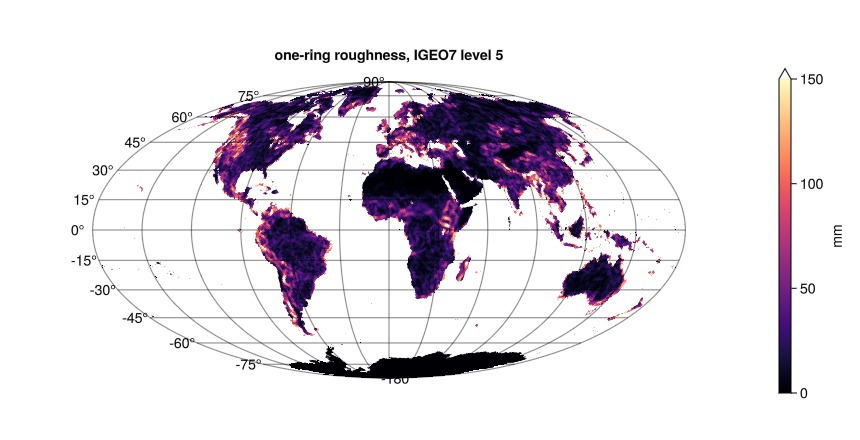
Run the chunks in parallel
chunkplan records each owned chunk and its surrounding input data. This kernel uses the default one-ring neighborhood, so halo=1 is sufficient. A larger halo does not enlarge that callback neighborhood. A built-in second-order convolution is not currently available.
plan = DGG.chunkplan(A; halo = 1)MapChunkPlan(42 chunks, 168072 cells, halo=1, 23941 halo reads)split cuts the plan into pieces over disjoint chunks. Each piece writes a disjoint range of dest, so the pieces can run as separate tasks. Each active task needs memory for its own chunk and halo.
pieces = Base.split(plan, 4)
threaded = similar(A)
@sync for piece in pieces
    Threads.@spawn DGG.mapneighbors!(threaded, roughness, A, piece)
end
isequal(threaded, dest)trueA chunk's halo supplies the neighbours of every owned cell, so the chunked result matches the whole-cube result cell for cell. The sweep may read a foreign chunk again when it belongs to several halos; the plan controls those reads while keeping each callback's working set bounded. Sweeping a cube along its chunk lines covers plans, foreachchunk, and field requests (needs).
This page was generated using Literate.jl.